The line no checkout page wants to quote is paragraph 4.4 of the CMA's price transparency guidance (CMA209, 18 November 2025): "administration fees, however described, such as booking or processing fees" belong in the price you are first shown. That is the rulebook on drip pricing in one clause. If you cannot buy without the fee, the seller does not get to reveal it on the payment screen.
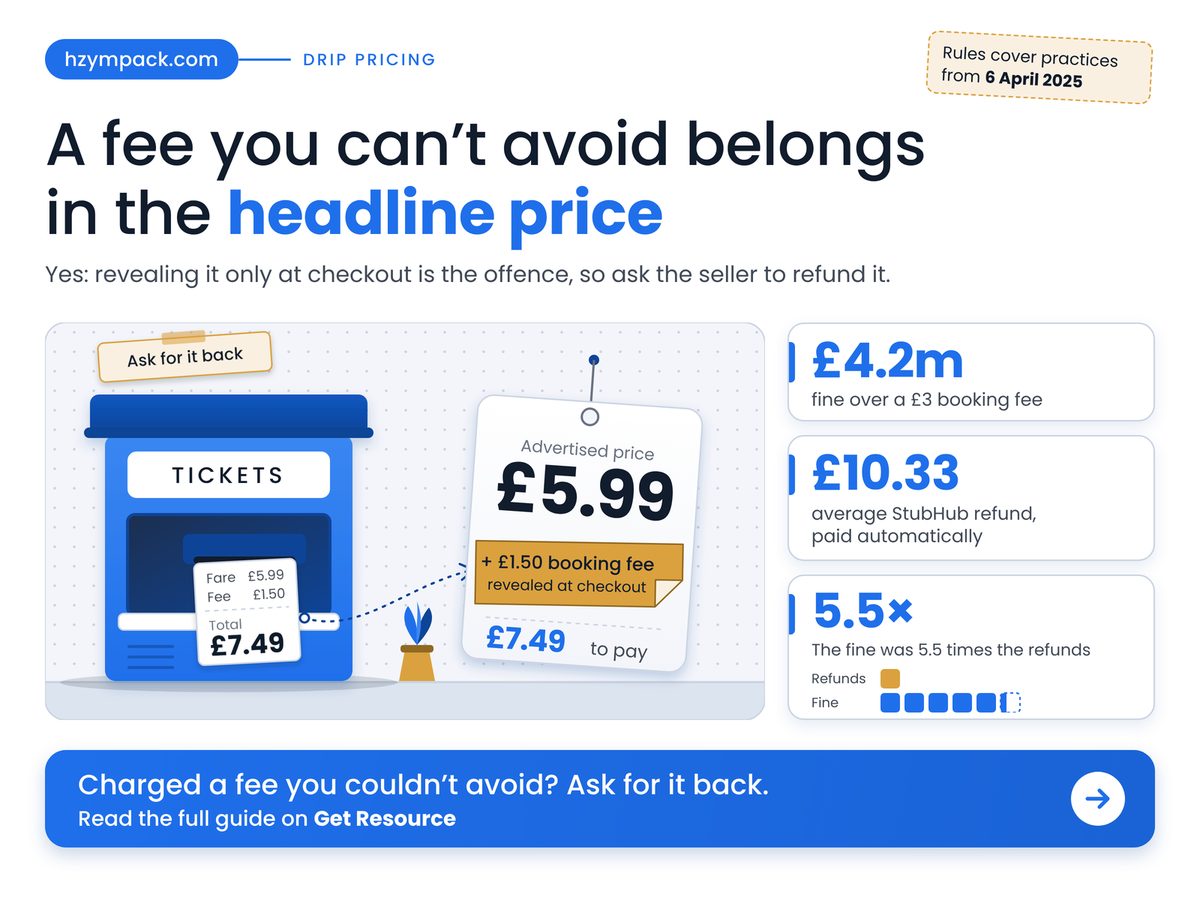
Yes: a booking fee you cannot avoid must be in the headline price, and revealing it at checkout is the offence.
- A fee is mandatory if you cannot buy the product without it, however the page labels it.
- A card-payment fee on top of the price is barred separately; optional extras are not covered.
- The CMA has fined firms for this and ordered refunds, some paid automatically.
- Keep a screenshot of the first price, then ask the seller to refund the late fee.
What Is Drip Pricing and Why Does It Matter?
Drip pricing is showing a low headline price, then adding mandatory fees later in the purchase; since 6 April 2025 the DMCC Act treats leaving those fees out of the first price as an unfair practice. It is not one of the 32 banned practices in Schedule 20. The CMA's guidance (CMA207, 18 November 2025) files it as an omission of material information under sections 225(4)(b) and 230, so cite those and CMA209 in a complaint. Schedule 20 is the wrong list.
The enforcement is real. On 15 April 2026 the CMA fined the AA and BSM driving schools £4.2 million over a mandatory £3 booking fee charged from April to December 2025: £7 million, less 40% for settling early. The ceiling is 10% of global turnover or £300,000 if higher, so settling looks rational. By our arithmetic that is 5.5 times the £760,000-plus ordered refunded, or roughly £9.50 for each of the 80,000-plus learners (both are lower bounds).
Two neighbouring rules: the UK subscription rules from January 2027 add a 14-day cooling-off on renewals, and EU right to repair, live since 31 July 2026, is another rule sellers would rather you did not quote.
StubHub UK's case, announced on 23 June 2026, shows the pattern at ticket scale. Delivery and service fees surfaced only at the final checkout stage, from 6 April to 7 December 2025. The CMA fined it £889,200 and ordered £590,000-plus back to 51,350 customers, £10.33 each on average: close to the AA learners' figure, so a fee worth a tenner can draw a fine. Four numbers decide whether chasing yours is worth it.
Hidden-Fee Period
8 months
Fees surfaced only at final checkout
AA and BSM Fine
£4.2m
Over a £3 booking fee
Customers Repaid
51,350
Refunded without filing a claim
Fine Against Refunds
5.5x
Derived from the CMA's own figures
What matters at your kitchen table is the route the money took. StubHub's buyers filed nothing: the CMA says affected customers need take no action, and refunds went back to the card used. Treat that as the exception. Without an order, nobody sends your fee back until you ask.
If you cannot buy without it, it is part of the price. Calling it a booking fee changes the label, not the rule.
Is It Illegal to Add a Booking Fee at Checkout?
Yes, if the fee is mandatory: under the DMCC Act a booking fee you cannot avoid must be in the headline price, so adding it at checkout is the unfair practice the CMA is enforcing. Find your situation below and read across.
| If you see | Do this | Because |
|---|---|---|
| 🧾 Fee at payment | Ask for it back, citing para 4.4 | Booking fees count as mandatory |
| 💰 Card fee | Dispute it with the seller | Para 4.6 bars card surcharges |
| ⚖️ Optional extra | Check you can buy without it | Para 4.2: mandatory only if you cannot |
| 📊 Price per person | Read the total once you add numbers | Paras 4.14 to 4.17 allow unit prices |
| ⏱ Before Apr 2025 | Ask anyway, expect a harder case | The DMCC rules start from 6 April 2025 |
Two rows settle most disputes: could you have bought without the fee, and is it a card surcharge. On a small fare the sting is the percentage, not the pounds (or not only the pounds).
A small fee on a small fare is a quarter on top of the price you were shown, so compare all-in totals, not headlines. Source: Which? spot checks, 21 May 2025, no sample size stated; the 20% share of the final price is our own arithmetic.
Worked example: take a £20 coach fare with a £1.50 booking fee, booked 8 times a year, with 19 months since the rules began on 6 April 2025. These are assumptions, not findings. Step one: £20 + £1.50 = £21.50 all-in. Step two: £1.50 ÷ £20 = 7.5% on top of the headline, so divide your own fee by your own first price. Step three: £1.50 × 8 = £12.00 a year. Step four: £12.00 × 19 ÷ 12 = £19.00 paid since 6 April 2025. Put your numbers in below.
Can You Get a Refund for a Hidden Booking Fee?
Sometimes: where the CMA has made an order, as with StubHub, refunds come automatically to your card; otherwise you must ask the seller, cite CMA209 paragraph 4.4 and keep proof of the first price you saw. Our call: ask in writing the week you notice, rather than wait for a regulator that can only take on a few firms. The limit: if you could have bought without the fee, it was optional under paragraph 4.2 and the claim collapses, so check that first against the CMA's price transparency guidance.
The rules stop short in places. The total-price rule covers how a price is marketed, not how or when you pay, so instalments are a separate question. Blaming a third party gets a seller no cover: paragraph 4.5 puts unavoidable supplier costs in the headline. Outside a CMA case the chase is yours alone, as with a closed Meta ad account balance.
- The CMA's investigations into Trainline, Virgin Atlantic and RED Driving School (19 August 2026) cover rail fees of £0.59 to £2.79, resort fees and £7-plus booking fees; no conclusions yet, so they show scope, not guilt.
- Each CMA case repays only its own period, so a fee outside it needs its own request.
- A per-person or per-kilo price can be lawful if the unit price is shown prominently and the total appears once you enter a quantity.
Check these before you ask for the fee back
- The fee line first appeared on the payment page, not in the price you first saw.
- You could not have completed the purchase without paying it.
- You still hold the first-price screenshot and the confirmation email.
- The fee is not a card surcharge, which has its own rule and its own complaint.
This week, pull up your last three booking confirmations, find any fee that first appeared on the payment screen, and email each seller asking for a refund, quoting CMA209 paragraph 4.4 and attaching your screenshot of the first price. The decision is whether the fee was optional: if you could have bought without it, drop the claim; if not, send the email. General information, not legal advice.
How we checked this
We read CMA209 and CMA207 (both 18 November 2025), the CMA's AA and BSM release (15 April 2026) and its StubHub UK release (23 June 2026). The worked example assumes a £20 fare, a £1.50 fee and 8 bookings a year. No product was tested hands-on for this article. Last verified: 12 November 2026. Edited by Shajini, reviewed after publication. Spotted something out of date? Tell us and we will correct it.
No comments:
Post a Comment