Showing posts with label Technology. Show all posts
Thursday, August 20, 2026

AI Token Prices Collapsed In 2026 But Your Bill Grew

AI Token Prices Collapsed In 2026 But Your Bill Grew

Your finance lead forwards the August invoice with one question attached: why is this bigger than July when every vendor spent the summer cutting prices? Both halves of that question are true at once, which is exactly why nobody on the engineering side has a clean answer ready.

TL;DR: Per-token AI prices fell hard through mid-2026, and total AI bills went up anyway. Agentic workloads eat far more tokens per task than the chat queries most budgets were sized on, inference now outspends training, and few teams can see the meter running.

Why It Matters

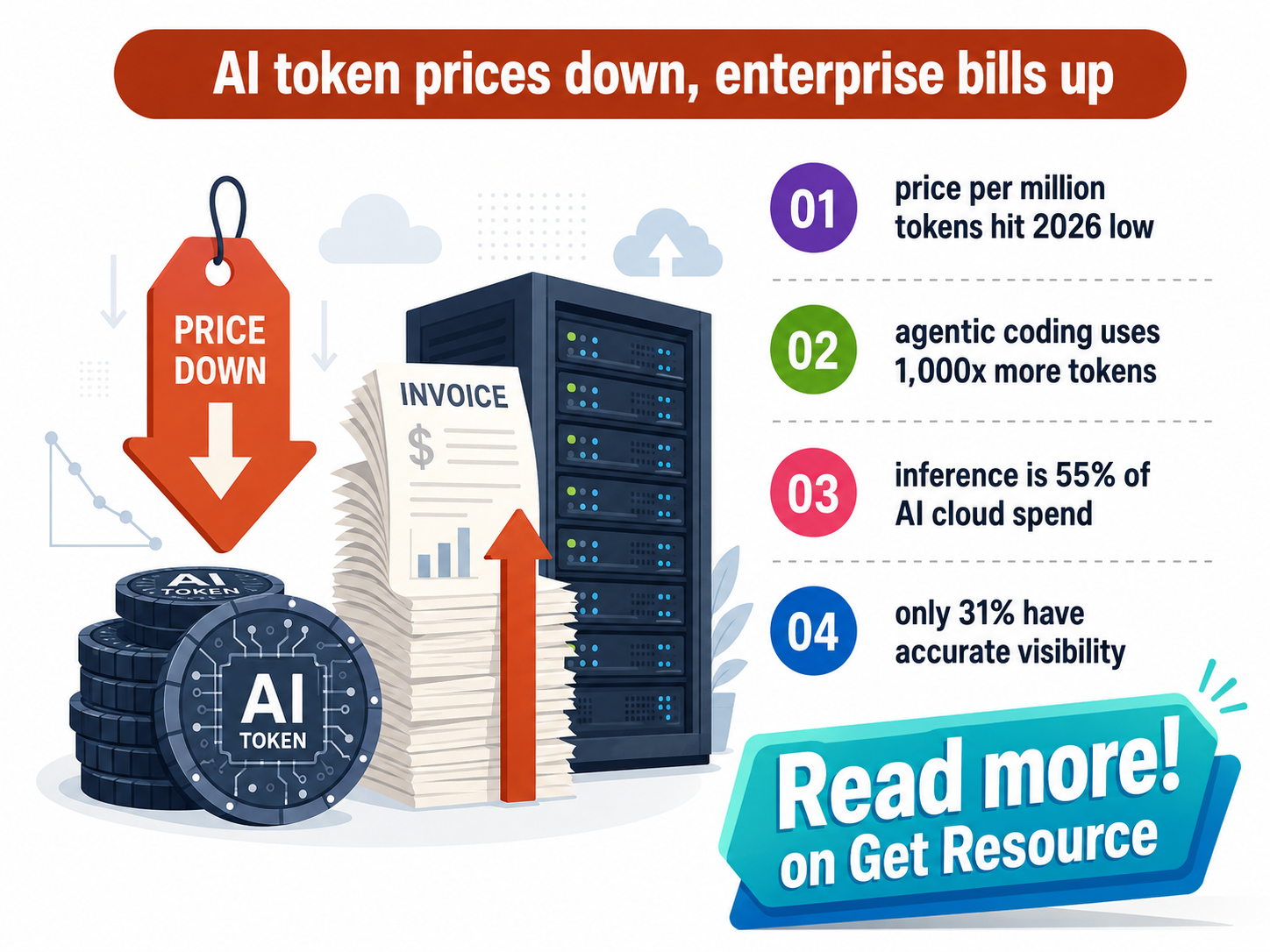
The cuts were real, not marketing. Jefferies, working from Silicon Data's pricing index, tracked average inference pricing down to a 2026 low in the first week of August, crediting reductions of up to 80% on OpenAI's flagship rates plus constant downward pressure from cheap Chinese open-source models. Back in March this site argued that cheap AI model API pricing could not survive real serving economics. Half right, at best. The floor did not hold, but it fell instead of rising.

So the unit got cheaper and the bill got bigger. That only looks like a contradiction if you assume the unit of consumption stayed still, and it did not. Gartner's 2026 numbers show inference overtaking training spend for the first time in the industry's history, which is what happens when models stop being projects and start being production traffic that runs every minute of every day. On top of that shift, the shape of a single request changed. EY's 2026 analysis priced one agentic interaction at roughly $1.20 against $0.04 for a simple linear workflow, about thirty times the cost for what a budget line still calls "a request." Where the industry is still guessing, in my view, is whether that premium is a transitional inefficiency that better routing and caching will grind away, or the permanent price of letting software think in loops. Nobody has the data to settle it yet, and anyone claiming otherwise is selling something.

Average inference price

$1.16

Per million tokens, 8 August

Time to that low

10 weeks

Measured from 31 May

Agentic coding token use

1,000x

Versus code chat tasks

Inference share of AI cloud

55%

First year above training

That third number is the one that quietly wrecks a forecast. The researchers behind it, a Stanford Digital Economy Lab and Microsoft Research group publishing in April 2026, found the cost sits on the input side rather than the output side: an agent re-reads its own accumulated history into context at every step, so a task that produces four lines of code may have read a small library to get there. Charge that pattern at last year's prices and you still lose, because the workload grew faster than the discount. It also explains why the honest ROI maths on small-business AI agents looked so tight even when the sticker price per million tokens was falling every quarter.

"

Ten weeks took a million tokens down to $1.16. Your agents burn a thousand times more of them than a chat box ever did. The discount never had a chance.

What The 2026 Numbers Actually Say

Strip out the vendor blogs and the figures that survive come from three places: an investment bank reading a pricing index, an analyst house forecasting cloud spend, and a peer-reviewed measurement of what agents actually consume. Here is the short version worth having on one screen before the next budget review.

Category Detail Insight
Price index Average inference sat at $2.04 per million tokens on 31 May 2026 (Jefferies, Silicon Data index) Unit cost stopped being the binding constraint
Spend mix Gartner puts 2026 AI-optimised IaaS at $42 billion, of which inference takes $23.3 billion Running models now outspends building them
Token appetite Gartner's March 2026 work found agentic models use five to thirty times more tokens per task than a standard chatbot query Demand grows faster than prices fall
Forecast risk Models predict their own token consumption at correlations of only 0.39, and systematically guess low Estimates fail in the expensive direction
Visibility Only 31% of the 512 IT professionals in Flexera's 2026 State of ITAM survey report accurate visibility into AI software spend Most teams cannot see the bill forming
Next year Gartner sees the same category reaching $66 billion in 2027, with inference at 59% of it Budget pressure gets worse, not better

Read the rows together and the pattern is plain. Every line that describes price is improving. Every line that describes consumption, forecasting accuracy or visibility is getting harder to manage. A cost problem you can measure is an engineering problem. A cost problem nobody can see until the invoice arrives is a governance problem, and those get solved much later and much more expensively.

49% delaying or cutting AI work on cost · 51% pressing ahead KPMG, 2026, against an average planned AI budget of $188 million per organisation

Roughly half of surveyed organisations are already slowing or shrinking AI programmes on cost grounds, which is what a price war looks like from the buyer's side of the invoice.

Friction Points

The uncomfortable part is that most of this spending is not waste in the obvious sense. It is work getting done at a price nobody quoted. Flexera's 2026 survey found 59% of respondents reporting more wasted software spend year over year, and wasted is doing heavy lifting in that sentence, because a retry storm, an over-eager retrieval step and a genuinely useful agent all look identical on a token meter. You cannot tag what you cannot attribute.

Compliance adds its own quiet overhead, and it landed this month. The EU AI Act transparency duties that switched on in August mean disclosure text, logging and audit trails riding along with production traffic, and every one of those is tokens or storage or both. Small per call. Not small at a million calls. And it arrives in the same quarter finance decided to start asking questions, which is either bad luck or a useful forcing function depending on how your quarter is going.

Watch for these before the next invoice cycle:

  • Context growth, not call growth. Track average input tokens per task weekly. A flat call count with rising input size is the classic silent doubling.
  • Retries billed as work. Failed agent runs consume the full context before they fail (and yes, that includes the one that failed silently last Thursday). Meter them separately or they hide inside your success numbers.
  • Model choice by habit. The same task on two frontier models can differ by more than a million tokens. Route by task class, not by whichever model the team liked in January.
  • Estimates written by the model. If your capacity plan came from asking an assistant what a workload would cost, assume it guessed low and rebuild the estimate from logged runs.

Key takeaways

Gartner expects worldwide AI spending to reach $2.52 trillion in 2026, up 44% year over year, so the money is not going back in the box.

Cheaper tokens make experiments affordable and production expensive at the same time, and the second effect is larger.

Attribution beats negotiation right now. A per-team, per-workflow token view is worth more this year than another round of vendor discounts.

Stop treating the price sheet as the story. Pull last month's logs, split token spend by workflow rather than by vendor, and find the three workflows carrying the largest input growth. If you cannot produce that split by Friday, that gap is your actual problem, not the price per million tokens.

Monday, August 3, 2026

EU AI Act August 2026: What Actually Applies To You

A support bot on a Dublin storefront has been greeting customers for a year without once mentioning it is software. On Sunday that was a design choice. On Monday it became a gap in the file. And the operator running it almost certainly believes the EU AI Act got postponed, because that is the headline that ran everywhere in June.

EU AI Act August 2026: What Actually Applies To You

TL;DR: 2 August 2026 was never cancelled. The high-risk rules moved to December 2027, but Article 50 transparency, general-purpose AI enforcement powers and the penalty regime all switched on as scheduled. If you run a customer-facing bot in the EU, the live obligation is yours.

Why the delay headline sent everyone to the wrong file

Two separate clocks got merged into one story. The Digital Omnibus on AI, tabled by the European Commission in November 2025 and given final Council approval on 29 June 2026, pushed the high-risk obligations back hard. Annex III systems (recruitment screening, credit scoring, education, essential services) now apply from 2 December 2027. Annex I systems, the ones baked into regulated products like medical devices and machinery, moved to 2 August 2028. That is a real reprieve, and teams that spent 2025 building conformity assessments earned it.

But the Omnibus left the other clock alone. Article 50, the transparency chapter, came into application on schedule. It is short, it is unglamorous, and it reaches far more businesses than Annex III ever did. People talking to an AI system have to be told they are talking to an AI system, unless that is obvious from context. AI-generated or manipulated content, deepfakes above all, has to be disclosed as such. AI-generated text published to inform the public on a matter of public interest has to be labelled unless a human editor takes responsibility for it. None of that requires you to be a model provider. It requires you to have a chatbot, or a content pipeline, and EU users.

The second live change is enforcement. General-purpose AI obligations have technically applied since August 2025, but with nothing behind them. The European Commission's AI Office can now compel documentation, run evaluations and issue fines against general-purpose model providers, and the ceiling it works with is the number worth internalising below. That matters to more than the frontier labs. If you fine-tune an open model, substantially modify one, or white-label it into the EU market, the provider classification question is suddenly worth an hour with a lawyer. Anyone who has read our breakdown of why cheap AI model API pricing will not survive the decade already knows the industry is being repriced from below. Compliance is now part of that price.

ENFORCEMENT DATE

2 Aug 2026

Article 50 and penalties

MAXIMUM GPAI FINE

15M euros

Or 3% of global turnover

WATERMARKING GRACE

4 months

Runs out 2 December 2026

ANNEX I SLIP

2 Aug 2028

AI inside regulated products

The four-month figure is the one people misread. Article 50 splits into a human-facing duty and a machine-readable one, and only the second got breathing room. Systems already on the market before this month get until early December before they have to embed provenance metadata and watermarks, because the technical standards for doing it are still catching up. The line your bot shows a customer got no such extension. Your disclosure text is due now. Your watermarking is due at the end of the year. Teams reading a single grace period into both halves are the ones who will be surprised. A 27 May 2026 Gibson Dunn client alert on the Omnibus agreement pinned the size of that reprieve at roughly 16 extra months for Annex III teams, and plenty of them have quietly stopped work rather than spending it. That instinct is understandable and it is a mistake, because the same AI inventory that satisfies a documentation request this year is the one those obligations will demand in 2027. If you are still budgeting agents as a line item rather than a governed asset, our look at the real costs and honest ROI of AI agents for small business is the cheaper place to start.

"

A ceiling set at three percent of global turnover is not a rounding error for anyone who fine-tunes a model and ships it into Europe.

Three regimes, three clocks

Most compliance confusion this summer comes from treating the AI Act as one deadline instead of three overlapping regimes with different owners, different evidence and wildly different exposure. Lay them side by side and the priority order stops being a debate.

Dimension Article 50 Transparency GPAI Obligations High-Risk (Annex III)
Applies From Now, this month Duties since 2025, fines now December 2027
Who It Binds Providers and deployers alike Model providers and modifiers Providers, then deployers
Core Duty Disclose AI, label content Documentation, copyright, testing Conformity assessment, oversight
Effort To Comply Hours, mostly copywriting Weeks, legal plus engineering Quarters, with external audit
Evidence Needed Screenshots of the disclosure Training data summary, test logs Full technical file, risk logs
Grace Period Only for machine-readable marking None remaining Sixteen months of runway
First Regulator Move A complaint from a user A documentation request Nothing yet
Best Suited For Product and marketing, this week Legal and engineering, jointly A named owner with budget

Read down the Effort To Comply row and the sequencing writes itself. The obligation that binds the most companies is also the cheapest one to satisfy, and it is the one that has had the least attention paid to it all year. That inversion is the whole story of this deadline.

1 Aug 2024 · 2 Feb 2025 · 2 Aug 2026 · 2 Dec 2026 · 2 Dec 2027 · Act in force · Bans apply · Article 50 live · Watermarks due · Annex III lands · You are here

The timeline above shows five application dates for the EU AI Act, running from entry into force in August 2024 through the deferred Annex III high-risk obligations in December 2027, with the current month marked as the transparency and enforcement milestone.

Where this goes wrong in practice

Enforcement capacity is the honest caveat. Several member states have still not stood up the market-surveillance authorities the Act assumes, so the first year is going to look uneven from the outside. My read, and it is a read rather than a fact, is that the gap closes faster than the optimists expect, because a documentation request costs a regulator almost nothing to send and is the standard opening move. The organisations that struggle will not be the ones with weak policies. They will be the ones that cannot answer a simple question inside a week: what AI is running here, who owns it, and what is it for.

There is a familiar shape to this. European regulators have run the same play on packaging, where extended producer responsibility rules turned a procurement detail into a balance-sheet item almost overnight, something we traced in our piece on how sustainable packaging technology is reshaping the supply chain. The pattern repeats: a quiet compliance clause, a slow start, then a sharp acceleration once the first penalties land and procurement teams start putting the question into their vendor questionnaires. Your customers will ask before your regulator does.

  • Disclosure lands between legal, marketing and product, which in practice means it lands on nobody. Name one owner or it will not get done.
  • Voice agents get forgotten. Teams patch the web chat widget and leave the phone system saying nothing at all.
  • "Obvious from context" is doing heavy lifting in a lot of internal legal memos. It usually holds for an internal tool and rarely holds for anything a customer or applicant touches.
  • Shadow AI breaks the inventory before it starts. The tools a team adopted without asking are exactly the ones missing from the sanctioned list.
  • Non-EU businesses assume they are out of scope. Serving EU users is the trigger, not being established there.

Three changes that missed the coverage entirely

  • A new Article 5 prohibition now bans AI systems generating non-consensual intimate imagery and child sexual abuse material, with a transitional period running to 2 December 2026. It reaches any general-purpose image or video tool where that output is a foreseeable, reproducible result without meaningful safeguards.
  • The deadline for member states to establish national AI regulatory sandboxes slipped by a year, to 2 August 2027, which is part of why supervisory capacity is thin right now.
  • The Article 4 AI literacy duty was softened. Providers and deployers must support the development of AI literacy among staff rather than guarantee a level of it, a wording change that quietly removes an unmeasurable standard.

Open your product this afternoon and find every place a machine talks to a human on your behalf: web chat, phone agents, automated email replies, generated blog copy. Add the sentence that says it is AI. Write down the date you did it and who signed off. That record is worth more in an inquiry than any policy document you could commission, and unlike the high-risk file, it is finished by Friday.

Monday, July 13, 2026

AI Agents For Small Business: Real Costs And Honest ROI

A three-person accounting shop in Leeds spent nine months answering the same four client questions by hand. Refund status. Filing deadlines. Where do I upload this. Did you get my form. Then they wired a support bot into their shared inbox and watched the queue fall by half in a fortnight. No new hire. No rebuild. One narrow, boring job handed to software that never clocks off.

TL;DR: AI agents for small business have moved past the hype. Real deployments now run roughly $200 to $500 a month and tend to pay for themselves in about five months. The whole game is scope. Point one at a single painful, repetitive task and it earns its keep. Aim it wide and it stalls.

Why this matters more than another chatbot demo

An agent is not a chatbot with better manners. It takes a goal, breaks it into steps, calls other tools on its own, and finishes a task without a person clicking through every screen. That jump in usefulness is why the category is growing at more than 45% a year, with vendors racing to package agents a small firm can switch on in an afternoon. A 2026 Gartner outlook expects task-specific agents to go from a rare bolt-on in 2025 to a plain default inside the business apps you already pay for. Small teams feel that shift first, because they were never carrying spare headcount to absorb grunt work.

AI Agents For Small Business: Real Costs And Honest ROI

Strip out the noise and four numbers decide whether an agent is worth buying: how long until it pays for itself, what it costs to run, how big the surrounding market has grown, and how owners actually feel after living with one.

PAYBACK TIME
5.1 months
Median across deployments
MONTHLY COST
$200-$500
Typical small-firm stack
MARKET SIZE
$10.9B
Agent market in 2026
OWNER SENTIMENT
93%
Report a positive impact

Payback is the one that changes the conversation. When the money you sink into setup comes back inside half a year, buying an agent stops feeling like a gamble and starts looking like a delayed hire that happens to work weekends. And because a running agent can quietly hand back around 6 hours and 20 minutes of a two-person support team's week, the saved time compounds long after the invoice clears. The Goldman Sachs 2026 small-business read backs the mood: owners who adopt rarely regret it.

Not every agent does the same job

Buying "an AI agent" is like buying "a vehicle." A delivery van and a motorbike both move, but you would not swap one for the other. The three flavors small firms reach for first all solve different pain, carry different setup effort, and break in different ways. Line them up before you spend a rupee or a dollar.

Dimension Customer-Service Agent Marketing / Content Agent Ops & Workflow Agent
Best first job Deflecting repeat questions Drafting and scheduling posts Moving data between apps
Setup effort Low, measured in days Low, measured in days Medium, measured in weeks
Time to positive ROI About 4.1 months Fast, campaign-led Slower, integration-led
Data it needs Past tickets and FAQs Brand voice and assets Clean records and access
Main failure mode Confident wrong answers Off-brand, generic output Broken hand-offs between systems
Human still needed for Edge cases and refunds Final approval and taste Exception handling
Best Suited For High-volume, repetitive inboxes Lean teams shipping steady content Firms drowning in copy-paste work

Read that table as a warning, not just a menu. Most small firms get the best first win from the customer-service column because the work is repetitive, the data already exists in old tickets, and the payoff shows up on the calendar fast. The ops agent is the biggest prize and the biggest trap, because it only shines once your records are clean and your apps talk to each other.

Generative AI use among small businesses climbed from 23% in 2023 to 40% in 2024 and 58% by 2026, which is the fastest small-firm tech uptake the Federal Reserve had ever tracked.

Where these things quietly go wrong

Here is the part the demo videos skip. An agent is only as good as the plumbing behind it, and small firms usually have the messiest plumbing. Half-finished records. Three apps that do not share a login. A spreadsheet someone swears is the source of truth. Drop a capable agent into that and it will confidently do the wrong thing at scale, which is worse than doing nothing.

The people problem bites just as hard. Staff who fear being replaced will not feed the agent the context it needs, and a starved agent looks like a failure even when the software is fine. Get the team on side early or the rollout dies quietly. And there is a real grey area nobody has fully solved: Gartner warns that more than 40% of agentic AI projects will be scrapped by the end of 2027, usually killed by fuzzy goals and creeping cost rather than bad technology.

  • Integration is the top wall, cited by 46% of adopters, because the agent has to reach into tools that were never built to talk to each other.
  • Implementation cost stops another 43%, especially when a cheap pilot balloons once you add real data and edge cases.
  • Data quality and access trip up 42%, since an agent cannot reason over records that are missing, stale, or locked away.
  • Employee resistance and training gaps hit 51% of small firms, the one barrier that hurts them more than big enterprises.
68%
of 10-100 employee firms now run AI, up from 47% a year earlier
5 tools
the median AI stack per adopting small business today
84%
name efficiency and productivity as the biggest gain

Pick your single worst repetitive task this week, the one that eats an afternoon and teaches you nothing, and pilot one agent against just that. Keep a human on the exceptions, measure the hours it returns, and only widen the scope once the first job is boringly reliable. That narrow, unglamorous discipline is the whole difference between AI agents for small business that pay for themselves and the 40% that get quietly switched off. 

Wednesday, November 15, 2023

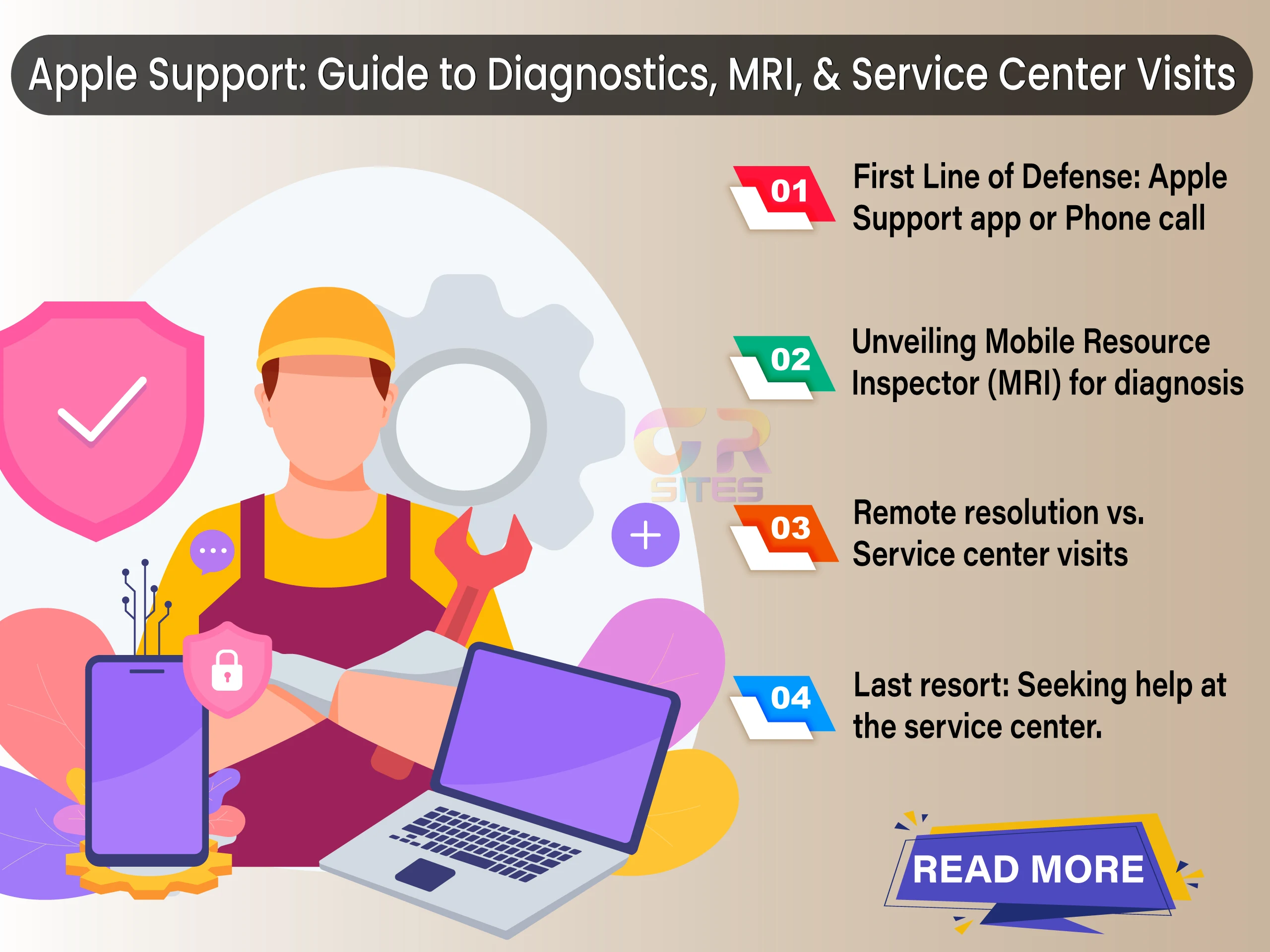
Decoding Device issue Dilemmas: Navigating Apple Support Like a Pro!

In the complicated web of technology, the occasional glitch or abnormal behavior of our cherished Apple devices can throw us into a state of perplexity. Fret not! This blog post is your guide through the maze of doubts and uncertainties, unraveling the process of connecting with Apple Support, demystifying the Mobile Resource Inspector (MRI), and determining when it's time for a visit to the service center.

First Line of Defense: Reaching Out to Apple Support
  • Navigating the Support Channels: Owning an Apple device is like having a digital sidekick, but what happens when it starts acting up? The first port of call is the Apple Support team. Whether it's the trusty iPhone, iPad, MacBook, AirPods, or the ever-dependable Apple Watch, a simple phone call or a checking out the Apple Support app initiates the troubleshooting journey.
  • Diagnostic Maestros: Apple's Technical Support Team - Once you've made the call or checked out the apple support app, you're not alone in the digital wilderness. Apple's technical support team, armed with expertise, is ready to decipher the cryptic signals your device is sending. They utilize the Mobile Resource Inspector (MRI) – a diagnostic tool that operates like a digital Sherlock Holmes, uncovering the mysteries of malfunction.
Decoding Device issue Dilemmas: Navigating Apple Support Like a Pro!
Apple Device Diagnostics: Unveiling the Mobile Resource Inspector (MRI)
  • A Peek into the MRI Process: Now, let's dive into the fascinating world of MRI. It's not a medical device but a digital detective that remotely probes your Apple device, seeking out the hidden culprits behind abnormal behavior. Think of it as a check-up for your gadget, but instead of a stethoscope, it uses virtual probes to identify glitches and malfunctions.
  • Remote Resolution vs. Service Center Visit - Once the MRI has completed its virtual investigation, the support team will guide you. If the issue can be remedied remotely, consider it a win – you've bypassed the need for a physical visit. However, if the ailment requires more hands-on attention, they'll suggest a trip to the Apple service center.
Service Center and Beyond: Knowing When to Visit
  • Battery Woes, Manufacturing Defects, and Accidental Repairs - Apple service center is the bastion of hands-on solutions. But when is it time to make that pilgrimage? If you're grappling with battery issues, suspect a manufacturing defect, or your device requires accidental repairs, it's a clear sign to pack your device and head to the service center.
  • Cautionary Note on Self-Repairs - In the age of online tutorials and DIY enthusiasts, the temptation to fix your Apple device at home might be strong. However, Apple, with its intricately designed devices, advises caution. Attempting self-repairs can lead to more woes than wins, turning a minor glitch into a major catastrophe.
  • Last Resort: When Self-Repairs Lead to Service Center Doors - If, despite the cautionary tale, you've ventured into the realm of self-repairs and found yourself knee-deep in digital chaos, fear not. The Apple service center is your beacon of hope. They specialize in fixing not only what ails your device but also the unintended consequences of well-intentioned DIY endeavors.
Conclusion
In the dynamic world of Apple devices, glitches and malfunctions are the occasional bumps in the digital road. Knowing how to navigate the labyrinth of support channels, leverage the Apple support app leveraged with diagnostic prowess of MRI, and discern when a service center visit is essential empowers you as a savvy device owner.So, the next time your iPhone, iPad, MacBook, AirPods, or Apple Watch seems to have a mind of its own, fear not. Armed with the knowledge from this guide, you can confidently face the quirks and ensure your beloved devices continue to be your trusty digital companions.
Saturday, October 14, 2023

Apple's Missing Piece: Battery Management in a Fast-Charging World

In the fast-paced world of technology, the battle is not just about who has the best features, but also who can make those features last. Apple, known for its innovation, lags behind Android in the crucial realms of battery management and fast charging. In this blog post, we'll delve into why Apple should adopt Android's battery management strategies to keep its users satisfied.

Apple vs. Android: A Charged Battle
  • Android Advantage: Let's face it, Android has been setting the gold standard in battery management and fast charging. While Android users revel in quick top-offs and longer-lasting batteries, Apple users can't help but feel the difference.
  • Apple's Struggle with Battery Degradation: Apple devices, while leading in numerous aspects, continue to grapple with battery degradation issues. Many users find themselves replacing their devices prematurely due to battery failures. A closer look at Android's approach could be the game-changer Apple needs.
  • Silent Shift: There's been a quiet shift in the tech world, where battery life is no longer a luxury but a necessity. The Android ecosystem has embraced this wholeheartedly, while Apple seems to be dragging its feet.
Apple's Missing Piece: Battery Management in a Fast-Charging World
Swift Charge, Swift Drain
  • Android's Fast-Charging Solutions: Android users often enjoy the benefits of fast charging without experiencing significant battery degradation. These devices incorporate charging systems that efficiently manage power intake, reducing wear and tear on batteries.
  • Apple's Cautious Approach: In contrast, Apple's approach to fast charging has been conservative. While it prioritizes battery health, it can leave users longing for a quicker top-up. Android's balance between speed and longevity is an aspect Apple should consider integrating.
Road to Harmony
  • Why Apple Needs to Adapt: As the tech world charges forward, Apple's lag in battery management and fast charging solutions could leave it out of the race. It's not just about keeping up but also delivering a seamless user experience.
  • Finding the Apple-Android Middle Ground: While Apple has prioritized battery health, it's time to bridge the gap between their approach and Android's solutions. Embracing Android's energy-efficient strategies without sacrificing battery life is the way forward.
Conclusion: Charging into the Future
Apple's innovation has led it to new heights, but in the race to provide a holistic user experience, battery management and fast charging are two critical facets that deserve attention. Emulating Android's strategies in these areas doesn't mean compromising on quality; it's about evolving to meet the demands of today's tech-savvy users. With a fresh focus on both battery longevity and fast charging, Apple can charge into the future with renewed vigor, keeping its users satisfied and always ahead of the curve.
Saturday, April 29, 2023

Aging Laptops and the Need for a Lite Operating System

Aging Laptops and the Need for a Lite Operating System
In today's fast-paced technological world, laptops have become an integral part of our daily lives. They serve as our portable workstations, entertainment hubs, and communication tools. However, unlike mobile phones that are frequently upgraded, laptops tend to age out slower due to their higher cost and longer lifespan. As a result, many users face challenges with the performance, compatibility, and security of their aging laptops and their operating systems. To address these issues, Microsoft and Apple should consider launching a lite version of their operating systems specifically designed for aging laptops, with limited features and support for basic software applications.

Challenges of Aging Laptops and Their Operating Systems
As laptops age, their hardware components and operating systems may not keep up with the demands of modern software and applications. Older laptops may struggle with slow performance, software incompatibilities, and security vulnerabilities. Operating systems that were once supported with regular updates and patches may no longer receive adequate support, leaving users at risk of security threats and compromising their overall user experience. This can lead to frustration and decreased productivity for laptop users who rely on their devices for work, communication, and entertainment.

Solution: Launch of Lite Version OS for Laptops
To address the challenges faced by aging laptops, Microsoft and Apple can consider launching a lite version of their operating systems. This lite version would be specifically designed for older laptops and would offer limited features and support for basic software applications. The lite version OS would be optimized for resource utilization, focusing on performance, compatibility, and security, tailored to the capabilities of aging hardware.

Benefits of Lite Version OS for Aging Laptops
The introduction of a lite version OS for aging laptops can bring several benefits to users, including:
  • Extended Lifespan of Laptops: By offering a lite version OS that is optimized for aging hardware, Microsoft and Apple can extend the lifespan of laptops that may not be capable of running the latest full-featured operating systems. This would allow users to continue using their laptops for a longer duration without having to invest in new hardware, reducing electronic waste and promoting sustainability.
  • Better Performance and Compatibility: The lite version OS would be optimized for resource utilization, resulting in improved performance and better compatibility with software applications. This would enable users to run basic software applications smoothly on their aging laptops, ensuring a seamless and productive user experience.
  • Enhanced Security and User Experience: With regular updates and patches, the lite version OS would provide enhanced security measures to protect aging laptops from security threats. This would ensure that users can continue to use their laptops without worrying about security vulnerabilities that may exist in older operating systems. Additionally, a lite version OS with a simplified user interface would offer a user-friendly experience, catering to the needs of older laptops users who may not be familiar with complex operating systems.
  • Cost Considerations: The cost considerations of upgrading to a new laptop can be a significant factor for many users. Purchasing a new laptop can be a substantial investment, especially if the existing laptop still meets basic needs but struggles with performance and compatibility due to an outdated operating system. Launching a lite version OS specifically for aging laptops can provide a cost-effective solution for users to extend the lifespan of their laptops without the need for expensive hardware upgrades.
How Microsoft and Apple can Implement Lite Version OS
Microsoft and Apple can implement a lite version OS for aging laptops by considering the following approaches:
  • Limited Features and Support for Basic Software Applications: The lite version OS should be designed to cater to the basic needs of users, offering essential features and support for basic software applications such as web browsing, email, document editing, and multimedia playback. Unnecessary features that may require higher system requirements can be omitted to optimize resource utilization and performance on aging hardware.
  • Simplified User Interface and Resource Optimization: The user interface of the lite version OS can be simplified to ensure ease of use for older laptop users who may not be familiar with complex operating systems. Resource optimization techniques, such as reducing background processes and unnecessary animations, can be implemented to minimize resource usage and enhance performance on aging hardware.
  • Potential Impact on the Laptop Market and User Adoption: The launch of a lite version OS for aging laptops can have a significant impact on the laptop market and user adoption. Many users who are hesitant to invest in new laptops due to cost considerations or environmental concerns may find the option of a lite version OS appealing. This can potentially lead to increased user adoption and extended lifespan of laptops, reducing electronic waste and promoting sustainability.
Moreover, the introduction of a lite version OS can also benefit users in developing countries or regions with limited access to high-end hardware. It can provide an affordable option for users to utilize their aging laptops and continue to meet their basic computing needs without the need for costly hardware upgrades.

My View: Embracing Lite Version OS for Aging Laptops
As laptops tend to age out slower and are often more expensive compared to mobile phones, the launch of a lite version OS by Microsoft and Apple can be a viable solution to extend the lifespan of aging laptops. By offering limited features and support for basic software applications, optimized performance, and enhanced security, a lite version OS can provide a cost-effective and sustainable option for users to continue using their aging laptops. This can contribute to reducing electronic waste, promoting sustainability, and catering to the needs of laptop users who may not require high-end hardware for their basic computing needs. There's more where this came from! Explore "G R Team Sites" for additional content on various topics.
Wednesday, March 22, 2023

TRAI's DND App Still Unavailable on Apple's App Store - What's Going On?

TRAI's DND App Still Unavailable on Apple's App Store - What's Going On?
In the present era, where we are persistently inundated with unsolicited phone calls and messages, a dependable DND (Do Not Disturb) application is an essential requirement. That's why the TRAI DND app was a game-changer when it was first launched. However, the application was not functioning properly and noticeably slow/unresponsive during the end. Only after few news coverage that it was evident that the application was removed from Apple’s app store due to non-compliance and lack application updates to support latest version of iOS. 

It is astonishing that such a critical application has been inaccessible for an extended period without any apparent clarification from TRAI. The impact of the app's absence was largely felt, as the app had the functionality to report spam calls and messages. With the unavailability of the app, it has become very complicated to report calls and messages and the number of spam calls/SMS has also considerably increased. 

Has TRAI abandoned the app? Is it still being worked on? It's frustrating to be left in the dark about something as important as a DND app that we all rely on.

In conclusion, it's time for TRAI to provide some clarity on the status of the DND app. Whether it's developing a newer version of the app, addressing technical difficulties, or just discontinuing the application, consumers should be informed of the situation. Without any updates, it's hard to remain confident in the app's usefulness and effectiveness. Let's hope that TRAI will address this issue soon and restore the DND app to its rightful place on the App Store.


Friday, February 3, 2023

Impending Limitations of Google Photos Cloud Storage

 Impending Limitations of Google Photos Cloud Storage

Google Photos has been a popular destination for millions of users who want to store and manage their photos in the cloud. However, earlier Google promised to offer unlimited storage for high-quality photos and videos, making it a convenient and cost-effective solution for users who want to store their memories

The switch to counting storage for photos uploaded to Google Photos has come as a surprise to many users including me, who rely on Google Photos for photo storage needs. Unlimited Photo storage with additional 15GB of storage for Google drive seemed like a generous offer. But Google made announcement that photos stored on its cloud will account against its 15GB FREE storage plan, that may not be enough for all to meet their needs. This will require users to purchase additional storage plans, which can get quite expensive over time, especially for those who had vast old photo collection and need a lot of storage for their current device. Google's potential move is not without reason, as the company aims to reduce storage costs and improve the efficiency of its data centers However, it's important to consider the impact this will have on users who rely primarily on Google Photos for their photo storage needs 

The decision to limit storage to just 15 GB from Google will force users to purchase additional storage plans for users and overtime they may be forced to look for alternative external cloud storage partner for their storage needs. It is important for Google to re-consider user needs and find a way to balance storage costs with user needs. Please feel free to check out “G R Team Sites” for more such insights and suggestions.
Wednesday, December 21, 2022

Comparison between next generation Chromecast and smart android box

Comparison between next generation Chromecast and smart android box
I have been using first generation Chromecast for past several years and the device has been serving my needs and I was able to cast from all my mobile and laptop devices. However, in recent times I could feel the lag in the old streaming device and was not able to stream high-definition (HD) or live videos. So, I was looking to buy next generation Chromecast streaming device for my TV and was shocked to learn about its disadvantages. Following are my concerns on getting the next or latest generation of the Chromecast streaming device: 
  • High cost: The most important factor that was bothering me while looking out options to get the next generation Chromecast device was the cost and to my surprise, the device cost was completely exorbitant with no justifications on the new or unique features that was being offered and made me to look out for alternate affordable streaming devices available in the cost. 
  • Manual change between DTH TV and casting: Another important factor that was bothering me while looking at the latest generation of the Chromecast streaming device was the lack of support for the DTH connection and to switch over to the live watching experience of the TV, it must be done manually each time. This lack of support to the DTH streaming was showstopper to me and was complete let off from the shopping list. 
From the above reasons, it was evident that it was not making sense for me to shop for latest generation Chromecast streaming and was completely knocked out from my shopping list. For more such articles or information from my experience, please feel free to check out the articles published in “G R Team Sites”
Friday, October 7, 2022

Future iPads with wireless charging and Mag-safe support

 Future iPads with wireless charging and Mag-safe support

With the introduction of Mag-safe charging capabilities with universal compatibility to Qi wireless chargers for iPhone and AirPods, Apple is slowly transitioning to wireless charging for future devices. On this line, Apple may soon bring in wireless charging capabilities to its iPad lineups and there are few reasons on why Apple might adopt. Following are my reasons on bringing in wireless charging capabilities for iPad
  • Universal compatibility: Most important component of bringing in wireless charging to iPad was to enable universal compatibility across all handheld devices in Apple ecosystem and enable file transfers through Mag-safe technology. By bringing in wireless capabilities to iPad, Apple could bring in new accessories and reverse transfer capabilities through technology advancements 
  • May drop accessories support for cost reduction: One another major component for bringing in wireless charging capabilities is to reduce the e-waste and the cost associated with provided cables on each iPad devices. By transitioning to wireless charging, Apple could soon stop providing even cables in their packaging and may offer exclusive discounts for getting Apple patented Mag-safe chargers.
Above are few expectations from my end on why Apple might bring in wireless charging capabilities to iPad and how transitioning to Mag-safe could be the next big thing. For more such articles or information, please feel free to check out the “G R Team Sites”
Thursday, September 8, 2022

Disappointing AirPods Pro 2 launch in 2022

Disappointing AirPods Pro 2 launch in 2022

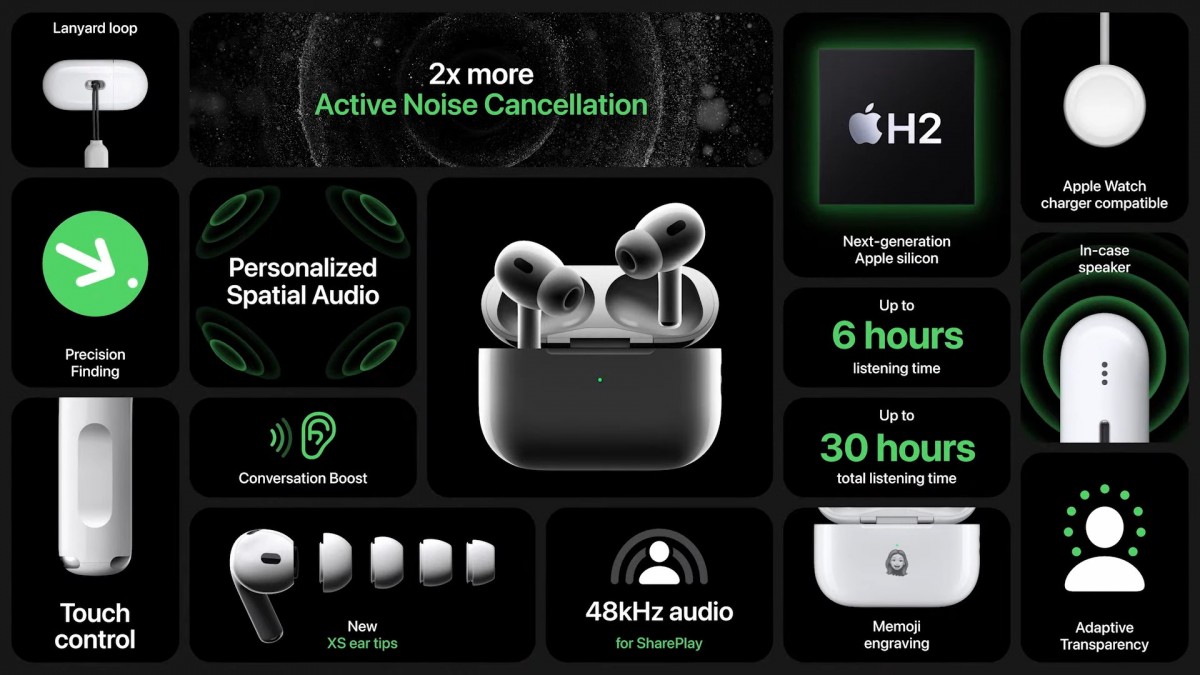
With reference to recent September event from Apple, the most awaited product from the enthusiasts was for the upgraded AirPods Pro 2 and its stand-out features. However, to everyone’s surprise Apple has launched the second generation of AirPods with the same design from first generation and has few more disappointments. My major concerns or disappointment on the launch for AirPods Pro 2 was as follows
  • Lack of lossless support or new audio formats: Even though Apple has mentioned that they are launching the 2nd generation of AirPods Pro with H2 Chip, there was not a single mention of support to Lossless audio format and there is major update on whether the new device would boost sound quality played from Apple Music or from third-party platforms. 
  • Lack of new fitness features as reported by rumors: The rumors were predicting that the 2nd generation AirPods Pro would have in-built sensors that would enhance the health monitoring capabilities and features. Another major disappointment contradicting the rumors prior to the launch was that there was NO introduction of any new health or fitness monitoring and tracking options. 
With above-listed concerns regarding to the 2nd Generation AirPods Pro, it would be wise from people to opt for the first generation AirPods Pro with much less price during the shopping sale and enjoy the same sound quality. To read more such articles, please visit the sites listed in “G R Team Sites”
Saturday, November 13, 2021

Annoying Hey Siri with multiple iPhone & iPad (s)

Annoying Hey Siri with multiple iPhone & iPad (s)

The most sought-after feature for most iPhone users is the experience of Siri and the option to summon Siri for assistance over voice. I personally feel the summoning Siri through “Hey Siri” have been the most frustrating thing, as I have around 5+ apple devices in my family and all have the “Hey Siri” option enabled by default. So, whenever I summon Siri on my iPhone, accidentally the Siri is summoned on my parent’s devices and the actions like reminders or alarms happens at the specific device. Such instances create nuisance for most iPhone users and wanted Apple to enable following options in the upcoming updates. 
  • a. User Voice Specific like Voice ID: While summoning “Hey Siri,” there should have been preference to enable Siri identifies the voice for that device and the Siri option is available only for that specific device(s) integrated into same iCloud. Apple could enable this preference by recording the voice modulation of the user and analyze the voice pattern of the user and enable the Siri available only to that specific user. This automation of voice identification of user can happen only at the device and can also encrypted, so the confidential information is not leaked like Face ID or Touch ID. 
  • b. Yes or no authentication: With introduction of Air Tags, it was evident that Apple could determine whether there are similar or other Apple devices nearby, similarly when “Hey Siri” was summoned it can detect whether there are other Apple devices nearby and can enable authentication for user like “Yes” or “No” mode to further act. 
I also have few more feature suggestion for Apple devices and iPhone’s and for more such articles, please feel free to check out “G R Team Sites”
Monday, August 9, 2021

Bundled Music Services in Microsoft Office 365

As stated in my earlier articles published in G R Team Sites that I have selected Microsoft's office 365 family as my preferred online cloud storage platform and have also enabled OneDrive as preferred photos backup option for all my family members. My preference on Microsoft’s office 365 family plan subscription was the option to enable 6 users to store or upload files with size up to 1TB individually and also enables all 6 users to access and use its office suite of applications. However, with all these rewards, I was still looking forward to Microsoft for introduction of bundled services like music and videos. Just by offering 1TB of online cloud storage and access to office suite of applications, will not hold users to stay long with Microsoft and with Apple having their own TV subscription services with launch of new series and movies every quarter, the competition was fiercer than before. While Microsoft focusing on offering its family office 365 subscription plan as more of storage option and office applications will not impress most common users across globe. Microsoft should revamp their strategy on Office 365 family plan and introduce new benefits like bundled music and movie subscription services to make users turnaround for its subscriptions and be market leader in online subscription services. To read more such articles or opinion from my end, please feel free to check out the articles published in G R Team Sites.
Friday, July 2, 2021

Issues with Office 365 and OneDrive online cloud storage  

So, after long thought I have opted OneDrive as my preferred online cloud storage platform. I was excited by opting for OneDrive as preferred online cloud storage for two reasons, one for exclusive access to office applications and other was large online cloud storage choice. However, after using it for past couple of months following are the few constraints that I encountered while using it. 
  • Cloud Storage with no option to device backup: Even though OneDrive offers large storage plan, it does not provide option to backup entire mobile device or entire system in MAC devices. Additionally, OneDrive does not allow users to select specific folders or files in MAC operating system. 
  • Office files Locking and collaboration: OneDrive cloud storage also offers exclusive access to office suite of applications and enables users to share license with 6 users. However, the office suite of apps does not allow users to lock and collaborate the office files. 
Hope Microsoft addresses above issues at the earliest, so users have the option to select their desired files/folders to synchronize with online cloud and allows users to lock confidential files and collaborate with assigned users with password protection. To explore more such articles, please feel free to check out the articles published in G R Team Sites.
Saturday, June 12, 2021

Online cloud storage (iCloud vs Onedrive vs Google drive) option comparison

For a long time, I was thinking about moving towards affordable online cloud storage option and I think, this topic would have been common among most users who were using Google photos as their online cloud storage option. With Google photos transitioning itself into paid online cloud platform, the decision was now left with users to decide on affordable and most trusted online cloud storage option. To clear most users doubts, I have detailed below table to help them find most affordable online cloud storage options available. 


Apple iCloud

Google Drive

Microsoft One Drive

Number of users

6 users

6 users

6 Users

Storage

200GB

200GB

6000GB

Affordable storage option

₹ 365.00

₹ 210.00

₹ 619.00

Yearly Cost

₹ 4380.00

₹ 2100.00

₹ 6199.00

Per Month Cost

₹ 365.00

₹ 175.00

₹ 516.58

Apple Music

₹ 99.00

0

0

Advantages

Apple Music

Google Photos

Office Apps

Per GB Cost

1.33

1.05

0.10


Please note, I have considered Indian currency as the base, as the cloud stores providers offer moist affordable options to Indian users and this comparison is applicable to users across globe. To get more such analysis, please feel free to check out the posts published in G R Team Sites.