The bill has one line you will read and one rule you will not be shown. The line is a rate per tonne. The rule is the awkward one: you can be made to register for plastic packaging tax even when your packs are clean enough to owe nothing. Few suppliers lead with that. And on 1 April 2027 the definition of "recycled" shifts under your feet.
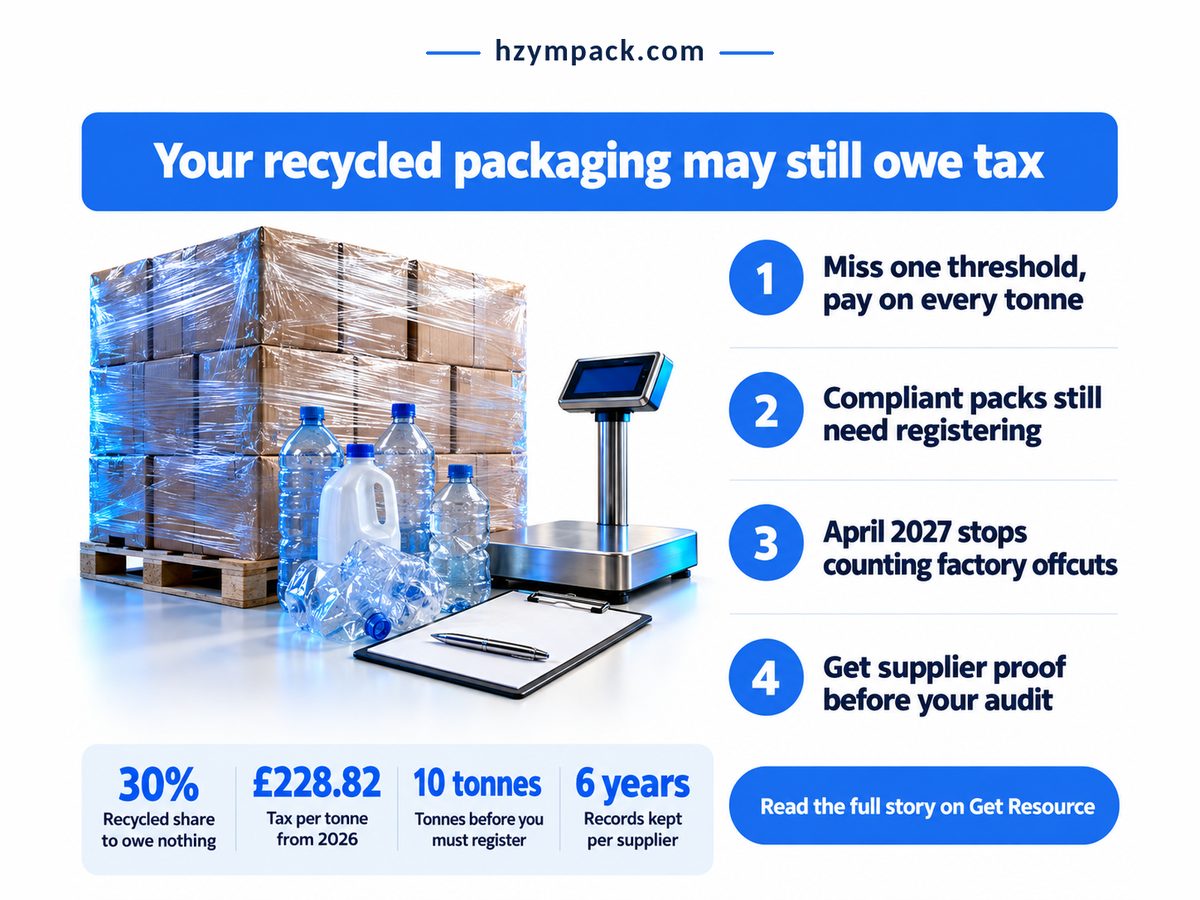
TL;DR: yes, a pack above the line still carries filing duty, and from April 2027 your recycled claim needs paperwork that survives an audit.
- Below 30% recycled plastic by weight the full rate applies; at 30% nothing is due.
- Registration is a separate test, triggered by tonnage rather than tax owed.
- Pre-consumer waste stops counting as recycled on 1 April 2027.
- Ask suppliers for third-party mass balance certificates now.
Why does the plastic packaging tax still bite a compliant pack?
Because registration and payment are separate duties: you register once you handle enough plastic packaging components, and you pay only on components below 30% recycled plastic, so a compliant pack still carries filing duty.
GOV.UK's business guidance sets the registration trigger at 10 tonnes of finished plastic packaging components manufactured or imported. For a small importer, that means registering before you owe a penny. Rödl's briefing of 6 March 2026 makes the sharper point: registration is required even when no tax is due because every component clears the line. A compliant pack still comes with a return, a deadline and penalty exposure. Read our take on the EU packaging EPR rules that went live in August and you will see the same pattern: the paperwork arrives first, the cost second.
Now the number. GOV.UK puts the rate from 1 April 2026 at £228.82 a tonne, up from £223.69 a year earlier. The line is a cliff, not a slope. At 29% recycled content you pay the full rate on the whole component; at 30% you pay nothing. Set against the £200 of 2022, my own arithmetic from GOV.UK's rate history gives a rise of about 14% in four years, so budget the next April step before it lands. The same cliff logic runs through California's packaging fees invoiced ahead of final rules: regulators publish the bill first and the detail later.
Four numbers decide whether this is a paperwork problem or a cost problem: where the line sits, what a tonne costs, when registration starts and how long you keep proof.
Tax per tonne
£228.82
Paid on every short tonne
Registration trigger
10 tonnes
Register before owing anything
Records to keep
6 years
Audit window you must cover
Recycled share needed
30%
Miss it, pay in full
The record-keeping duty is the one that outlasts everyone's memory. Staff move on, suppliers merge, and a certificate you cannot find is a claim you cannot make. Attach each delivery's declaration to the purchase order, not to someone's inbox.
A pack one point short of the line pays on every tonne it ships. The tax has a cliff, not a slope.
So the useful question is not whether your pack is green. It is which side of the line each pack lands on, and what you can show HMRC to prove it. The table below separates the two.
Which packs owe tax, and which only owe paperwork?
A pack below the recycled line owes tax and paperwork, while a pack above it owes paperwork alone, provided you pass the registration threshold and can prove every recycled claim to HMRC when asked.
| Category | Detail | What it means |
|---|---|---|
| 💰 Tax cost | £2,288.20 per 10-tonne run below the line | ⚠️ One point short costs the whole run |
| ⚖️ Registration | 30-day look-ahead or 12-month look-back | ⚠️ Compliant packs do not exempt you |
| 📊 Recycled share | Taxed under 30% by weight, free at 30% | ⚠️ Aim 2 to 3 points above the line |
| ⏱ Offcut rule | From 1 April 2027 pre-consumer waste stops counting | ❌ A 32% pack can fall under the line |
| 🧾 Proof | Mass balance, third-party certificate, quarterly balancing | ⚠️ Supplier certificates become your evidence |
| 🏁 Best suited for | Anyone importing plastic packs into the UK on a supplier's recycled claim | 🏁 Audit supplier paperwork before April |
Read down the middle column and one pattern shows: the tax is binary, so the only lever you control is margin. Read the right column and a second one shows: the paperwork is where most of the exposure sits.
The graphic settles whether a pack one point short of the line is worth fixing: it is, because the whole tonne is taxed, not just the missing 10 kilograms. The weights are my own arithmetic from the 30% threshold in GOV.UK's guidance.
What changes for recycled claims on 1 April 2027?
From 1 April 2027, pre-consumer plastic waste no longer counts as recycled, and chemically recycled plastic must be proven by mass balance with third-party certification meeting HMRC's minimum standards.
HMRC released preparation guidance and minimum certification requirements on 28 August 2026, but detailed guidance is not expected until early 2027, according to Packaging Gateway. The rules finalise months before the deadline, and your supplier contracts will not wait for them. My opinion, and only that: a rule landing this late is one HMRC expects importers to absorb at their own cost, so do not hold your breath for a grace period. Our note on sustainable packaging technology and supply chains covers why suppliers rarely volunteer this detail.
Mass balance is an accounting method: a recycler tracks how much recycled feedstock enters a plant, then attributes that amount to output. Packaging Gateway's summary lists an attribution declaration per delivery or batch, six-year record retention, quarterly balancing and site-specific conversion factors. Fuel-use material is excluded from the calculation, so a supplier claim that counts fuel outputs cannot count toward your percentage.
- Ask what share of each supplier's recycled content is pre-consumer waste.
- No third-party certificate, no recycled claim.
- Get written confirmation that fuel outputs are excluded.
- File declarations by delivery, not by quarter.
Conditions that should worry you
- Your recycled share sits within a few points of the line.
- Your supplier counts factory offcuts as recycled content.
- You make or import packaging components and have not totalled this year's tonnage.
- Your supplier cannot name the certifier behind its mass balance claim.
This week, pull your last twelve months of plastic packaging tonnage, ask each supplier for its offcut share and the certifier's name, then decide by month-end: reformulate with a safe margin above the line, or pay the rate and document everything else.
No comments:
Post a Comment