The pallet shipped in June. The bill for it arrived in a completely different shape: a producer registration number, an annual report with a hard filing date, and a fee schedule keyed to the exact multi-layer laminate somebody specified back in 2019. On 12 August 2026 the European Union's Packaging and Packaging Waste Regulation began to apply, and seven US states already had live programs pulling data from producers. Packaging quietly stopped being a procurement line and became a filing obligation.
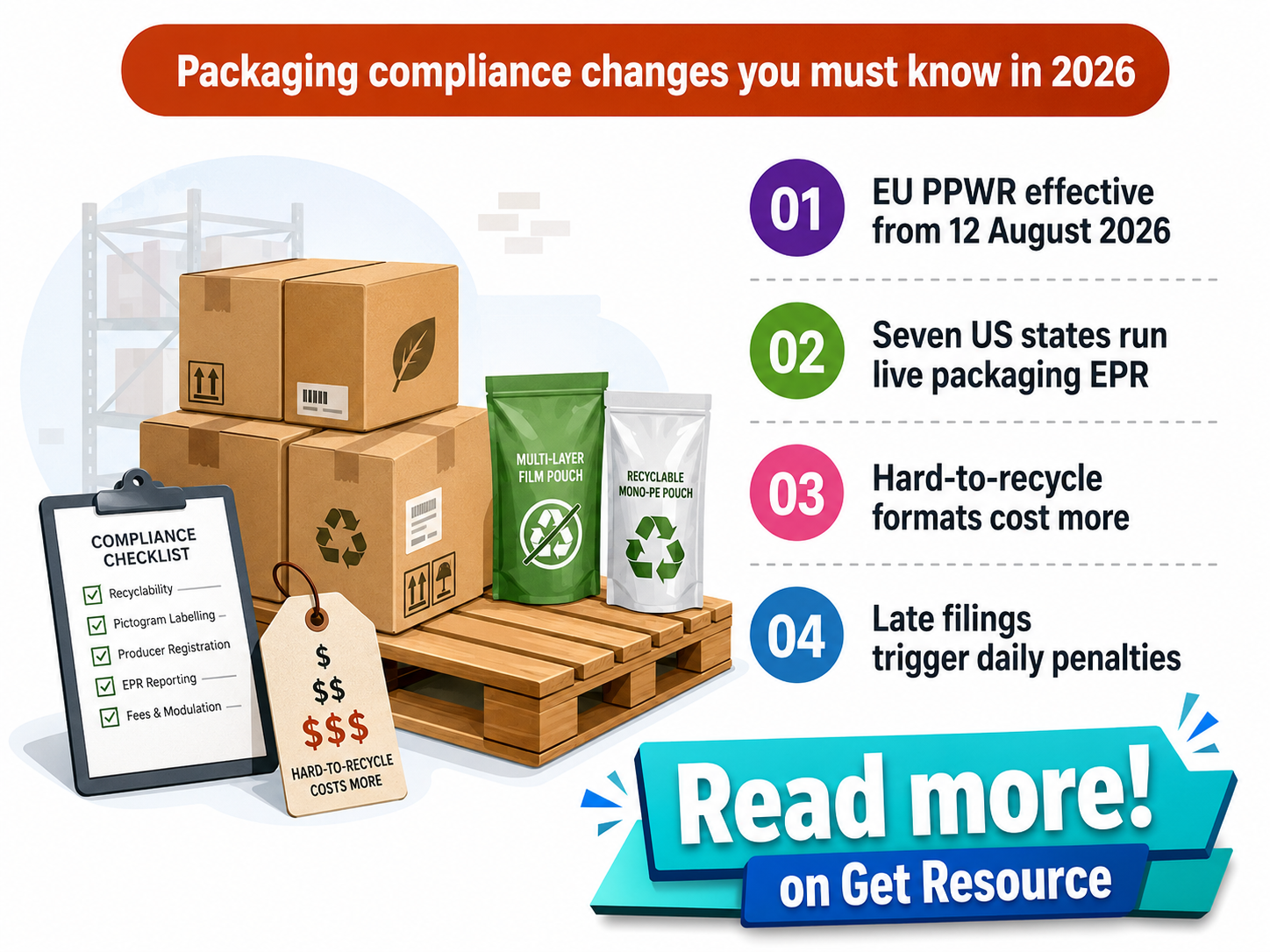
TL;DR: PPWR now applies across the EU, and seven US states run live packaging EPR programs. Recyclability, labelling and registration bite today. Recycled content and single use bans are deferred. Fees are eco-modulated, so the format you ship decides the bill, not the tonnage alone.
Why It Matters
Start with what is enforceable right now, because that is a much shorter list than the trade press suggests. PPWR's first tranche is design and paperwork. Every unit has to be recyclable. Heavy metals are capped across lead, cadmium, mercury and hexavalent chromium. Material composition travels on the pack as a pictogram now, not buried in a spec sheet. Producers must appear in a national register before anything is sold, distributors verify that they did, and online marketplaces assess the same evidence before listing. Brussels ran the identical staging pattern it used for the EU AI Act obligations that went live earlier this month: transparency duties first, the expensive structural rules years later.
The American side is messier, and messier is more expensive. Seven states now run packaging EPR, and 31 May 2026 dragged annual producer reports and pre program simplified reports into the same fortnight for six of them. That single clustered date is the part most teams underestimated. A filing is not a sustainability report. It wants unit counts, material weights and format detail per SKU, which means the material substitutions that have been reshaping supply chains since 2024 now have to be documented at the pack level rather than described in a slide.
And here is where the money actually sits. Eco-modulation means the fee is set by how hard your format is to recycle, not by how much of it you ship. Resource Recycling's April 2026 read of Colorado's interim base dues put more than $1.50 a pound between the cheapest and the most punished format, which is a bigger swing than most packaging teams have ever seen on a raw material line. So the cheapest option on the purchase order stops being the cheapest option on the year. It is the same shape as AI unit prices collapsing while enterprise bills climbed: the per unit number improves, the invoice does not.
Oregon Lifecycle Report
31 Dec 2026
Top 25 producers file
Late Filing Exposure
$10,000s / day
Reported penalty range
Separate PCR Filings
5 states
Outside the EPR reports
EU Recycled Content
10% to 35%
Plastic packaging from 2030
The penalty figure is the one that changes behaviour, and it changes it in an unhelpful direction. Because exposure accrues daily rather than per filing, a late or bounced submission turns into a running meter instead of a fine you can budget once and forget. That pushes teams toward filing something defensible on time rather than filing something accurate, and regulators have already started sending submissions back where the numbers do not line up. Nobody has built the audit capacity to catch that at scale yet.
The penalty runs by the day, not by the filing season. A late report is not a rounding error on your packaging spend. It is a meter.
What Actually Changed, Line By Line
Below is the part worth printing and taping to a wall, because the obligations arrived from four different directions and none of them share a vocabulary. Read it as a scope check rather than a calendar.
| Category | Detail | What It Decides |
|---|---|---|
| EU Register | National registers such as Germany's LUCID must list the producer before any sale | No register entry, no legal EU sale |
| Green Claims | Environmental claims permitted only where performance beats the PPWR minimum | Generic recyclable wording stops working |
| Scope | 3 formats pulled in: tea bags, coffee bags and permeable bags now count as packaging | Previously exempt lines need labels |
| PCR Dates | Connecticut, Maine and Washington file 1 April; New Jersey files 31 December | Three states share one April date |
| Fee Logic | Multi layer film, foam service ware and formats under two inches price highest | Format choice sets the invoice |
| Litigation | Oregon's program was enjoined in February 2026; SB 343 was challenged on 17 March 2026 | Rules can move mid compliance cycle |
| Data Owner | Pack specifications sit with suppliers while sales volumes sit in internal systems | Filings bounce when the two disagree |
Read that table again and notice how little of it is about recycling. Most of it is about evidence: who holds it, and how fast it can be produced when a program office asks. The calendar underneath is just as lopsided.
Four fixed points on the compliance calendar, running from California's source reduction plans through to the EU's single use bans at the start of 2030.
Friction Points
The standard advice this year is to hold off on redesign until the fee schedules settle. That advice is wrong, and it is wrong for a boring reason: the lead time on a format change is longer than the gap between fee announcements. Requalifying a laminate, revalidating a seal, retooling a line and clearing a customer's own spec review runs past a year in most categories. Wait for certainty and you will be paying the punitive rate through the whole requalification window you could have started in 2026.
The second problem is that eco-modulation is being sold as a recycling policy when it behaves like an industrial policy. That is my read, not a finding, and it is genuinely unsettled. If the fee gap is large enough to move material choice, it works. If it is small enough to pass through to the shelf price, it just becomes a consumption tax with extra paperwork, which is roughly what happened to every compliance regime that ended up squeezing whoever actually files. Nobody has a clean answer yet. Or rather, nobody outside the producer responsibility organisations does, and they are not publishing the elasticity data.
Then there is the software question. Compliance platforms are being pitched hard right now, and the honest arithmetic looks a lot like the real cost and ROI maths for small business automation: the tool is cheap, the data cleanup around it is not. Watch for these:
- Supplier specification gaps. If your vendors cannot give you gram weights and layer structures per component, no platform will fix that for you.
- SKU level mapping. Programs want packaging tied to units sold in that jurisdiction, which most ERP setups do not natively express.
- Claims already printed. Artwork approved before October carries recyclability wording that becomes a legal exposure the moment enforcement starts.
- Jurisdiction drift. An injunction in one state does not pause the filing clock in the other six.
Key Takeaways
One dataset, many owners. The filing needs supplier held specifications joined to internally held sales volumes. Whoever owns that join owns your compliance risk, and in most companies right now nobody does.
Cheapest on the PO is not cheapest on the year. Purchase price and fee exposure now point in opposite directions for exactly the formats procurement historically favoured.
Artwork is a legal document. Recyclability wording approved under the old rules does not grandfather in. Treat the label file as regulated content, not marketing content.
Pull your top twenty packaging formats by volume this week and score each one on two columns only: can a supplier give you the full material breakdown by weight, and would you defend its recyclability claim in front of a state program office. Anything scoring badly on both is your 2027 budget problem, and it is cheaper to find it now than in a bounced filing.
Related: California's 2026 EPR packaging fees
Related: how packaging EPR fees are already being invoiced in 2026
No comments:
Post a Comment