The line PackUK would rather you skimmed sits in its own modulation statement: from the 2026-27 invoice, every tonne of red-rated household packaging pays the amber fee times 1.2, then 1.6, then 2.0. Not a fine. A multiplier, set in policy in June 2025 and applied to packaging you already sold in 2025. If your notice of liability lands this winter, the packaging EPR fees on a red pack were fixed by last year's decisions, at a rate the regulator still calls illustrative.
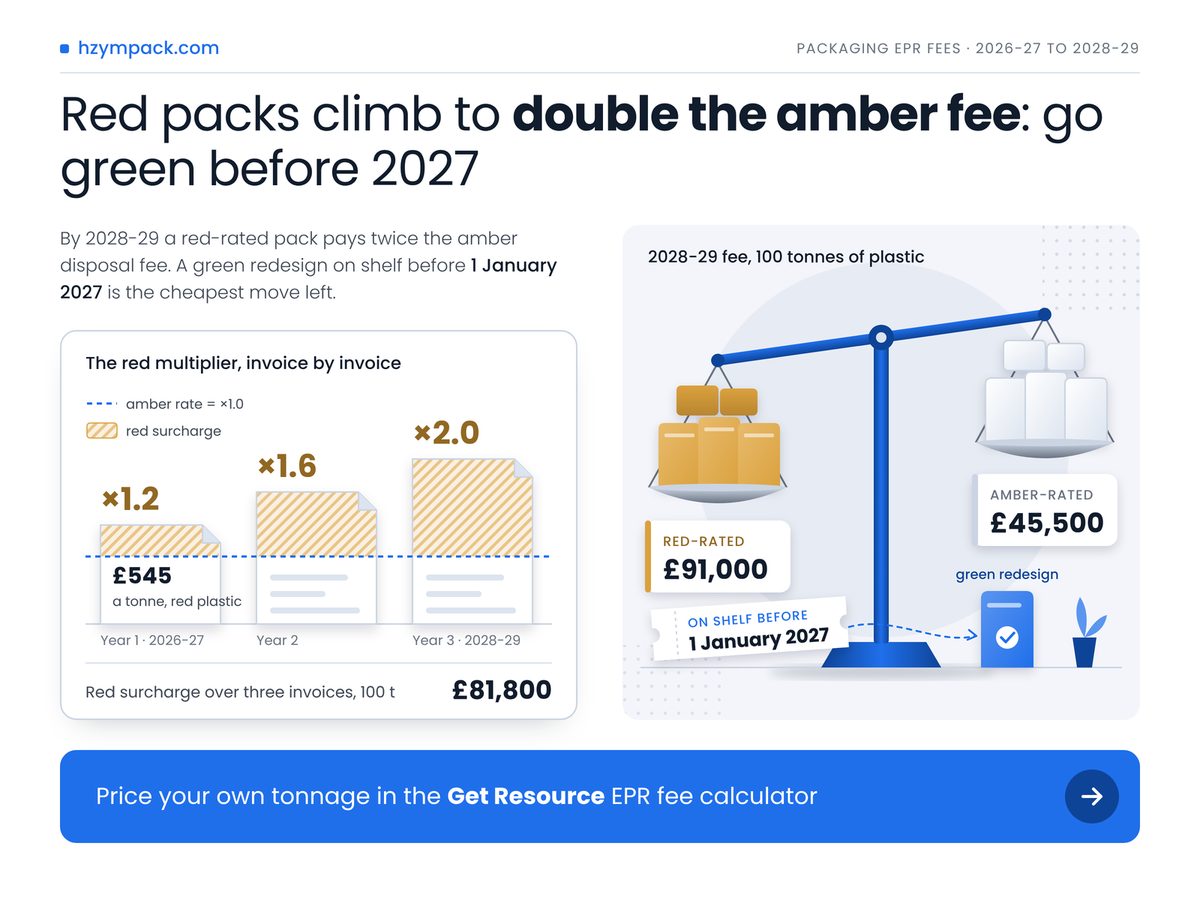
Key Takeaways: Red-rated packaging pays twice the amber disposal fee by 2028-29, so a green redesign on shelf before 1 January 2027 is the cheapest move left.
- The 2026-27 bill is already fixed by what you supplied in 2025; only 2026 and 2027 packaging can still change later invoices.
- On 100 tonnes of red plastic, the surcharge over amber totals £81,800 across three invoices if base rates hold flat.
- Every 2026-27 rate is still illustrative, so budget on the multiplier rather than the published pounds per tonne.
Why does a red RAM rating cost more every year?
A red rating costs more each year because PackUK's modulation statement multiplies the household disposal fee for red material by 1.2 in 2026-27, 1.6 in 2027-28 and 2.0 in 2028-29, while amber stays at base.
PackUK also says modulation does not raise total fees: red money comes back as an equal percentage discount on every green tonne. So the surcharge is a transfer. A red laminate pouch pays for a rival's mono-material one, and no invoice says so. Selling into Europe too? Our guide to EPR under the EU PPWR and seven US states runs on different data years.
The timing is what the scheme undersells. The statement says 2026-27 fees are calculated on packaging supplied in 2025, so that bill was settled when the stock shipped. On the same one-year lag, the 2.0 year reads 2027 supply, which makes 1 January 2027 the last date a redesign counts in full against the steepest invoice. That's about nine weeks away. Plastic lines also face the Plastic Packaging Tax mass balance rules from April 2027 change how recycled content is proved on the same packs.
Four numbers decide whether this is your problem. They come from PackUK and Defra's illustrative Year 2 fee table, published 16 December 2025, and the government's producer guidance, updated 19 August 2026, set against a year-one plastic base of £423 a tonne.
Supply Already Billed
12 months
All of 2025, beyond redesign
Red Plastic Rate, 2026-27
£545 a tonne
Derived: 29% above year one
Tonnage That Triggers Fees
Over 50 tonnes
Plus turnover above £2m
Green Discount, Illustrative
About 9%
Paid for by red tonnes
The green discount is the slipperiest of the four. Funded from red revenue, it floats with how much red the whole market reports, so if rivals clean up their packs, your reward for switching shrinks too.
Modulation raises nobody's total. Every pound a red pack pays above amber leaves the system as a competitor's green discount.
How much will packaging EPR fees add to a red plastic line?
On illustrative 2026-27 rates, a tonne of red plastic costs £90 more than amber, and with the base held flat that gap grows to £273 in 2027-28 and £455 in 2028-29.
Worked example: a brand supplied 100 tonnes of red-rated plastic household packaging in the data year. Assumptions: the amber base stays at PackUK's illustrative £455 a tonne and the line stays red. In 2026-27 the bill is 100 × £545 = £54,500, against £45,500 had it been amber. In 2027-28 it's 100 × £455 × 1.6 = £72,800. In 2028-29 it's 100 × £455 × 2.0 = £91,000. Add the three surcharges over amber (£9,000 + £27,300 + £45,500) and the red rating costs £81,800 across three invoices.
Find your row by tonnes of red plastic, then read across to the fee year: each cell is your extra over amber, base held flat.
| Red plastic | 2026-27 | 2027-28 | 2028-29 |
|---|---|---|---|
| 10 t | £900 | £2,730 | £4,550 |
| 50 t | £4,500 | £13,650 | £22,750 |
| 100 t | £9,000 | £27,300 | £45,500 |
| 500 t | £45,000 | £136,500 | £227,500 |
The shaded cell is the worked example's final year. One row down, that invoice carries £227,500 of surcharge; one column left, the 2027-28 bill, takes £18,200 off it.
Red over green, per tonne, 2026-27
If you can redesign only one red line this year, start where a red tonne costs most over a green one: fibre-based composite, then plastic. Each gap is our subtraction of the green rate from the red rate in PackUK and Defra's December 2025 illustrative Year 2 table.
What happens if my packaging is rated red under RAM?
If your packaging is rated red under RAM, you pay the multiplied disposal fee on every tonne, unless it is medical packaging a regulation forces into that format, which is reported as amber-medical instead.
The RAM recyclability rating is yours to declare. PackUK says producers self-assess against RAM v1.1, regulators check, and the newest RAM version applies when invoices are generated. So an unevidenced green claim is an enforcement risk, and today's amber pack can turn red if the method tightens.
Your rate also moves with other people's paperwork. Wood's illustrative amber fee is £450 a tonne against £280 in year one, a 61% jump PackUK and Defra blame on less wood being reported, some of it now filed under other categories. A pallet maker changed nothing and pays more. Our opinion, not a finding: a fee that swings this far on reclassification is a shaky base to multiply by two. US exporters saw the same with California's EPR packaging fees, invoiced while its rules were still draft.
- Confirmed 2026-27 rates were due in June 2026; ERP UK, a compliance scheme, reported on 17 September 2026 they could still change, with notices from November.
- Government guidance says a compliance scheme cannot pay your disposal fee for you.
- The multipliers stand until a review no later than 2028.
- Medical packaging is not exempt unless a regulation forces the red format.
Check these against your own data return
- Any household line you report as red tops ten tonnes a year.
- Your supplier can document the rating your return claims, line by line.
- A redesign quote can reach shelves before 1 January 2027.
- Your notice of liability arrives before PackUK's final rate table does.
Our call: pull your 2025 data return this week, list every household line reported red, and price each at twice its amber rate. Where that beats the redesign quote, change the pack before 1 January 2027. This is wrong for small producers, who pay no disposal fee, and for any redesign that would rate red under the next RAM version, so confirm your status on the government's producer guidance first.
How we checked this
We read PackUK's modulation statement (dated 28 June 2025, published 17 February 2026), PackUK and Defra's Year 2 illustrative fees (16 December 2025) and the Year 1 base fees (27 June 2025). The worked example assumes 100 tonnes of red plastic and an amber base held flat at £455 after 2026-27. No product was tested hands-on for this article. Last verified: 30 October 2026.
Edited by Shajini, reviewed after publication. Spotted something out of date? Tell us and we will correct it.
No comments:
Post a Comment