“Returns do not take into account the load and taxes, if any.” That line sits under Baroda BNP Paribas Mutual Fund's SIP table, as on 31 December 2024, and it is the rule your fund house would rather you never quoted. For a Rs 2,000 monthly investor, SIP returns in rupees are the only figure that pays a bill, and the page does not print them.
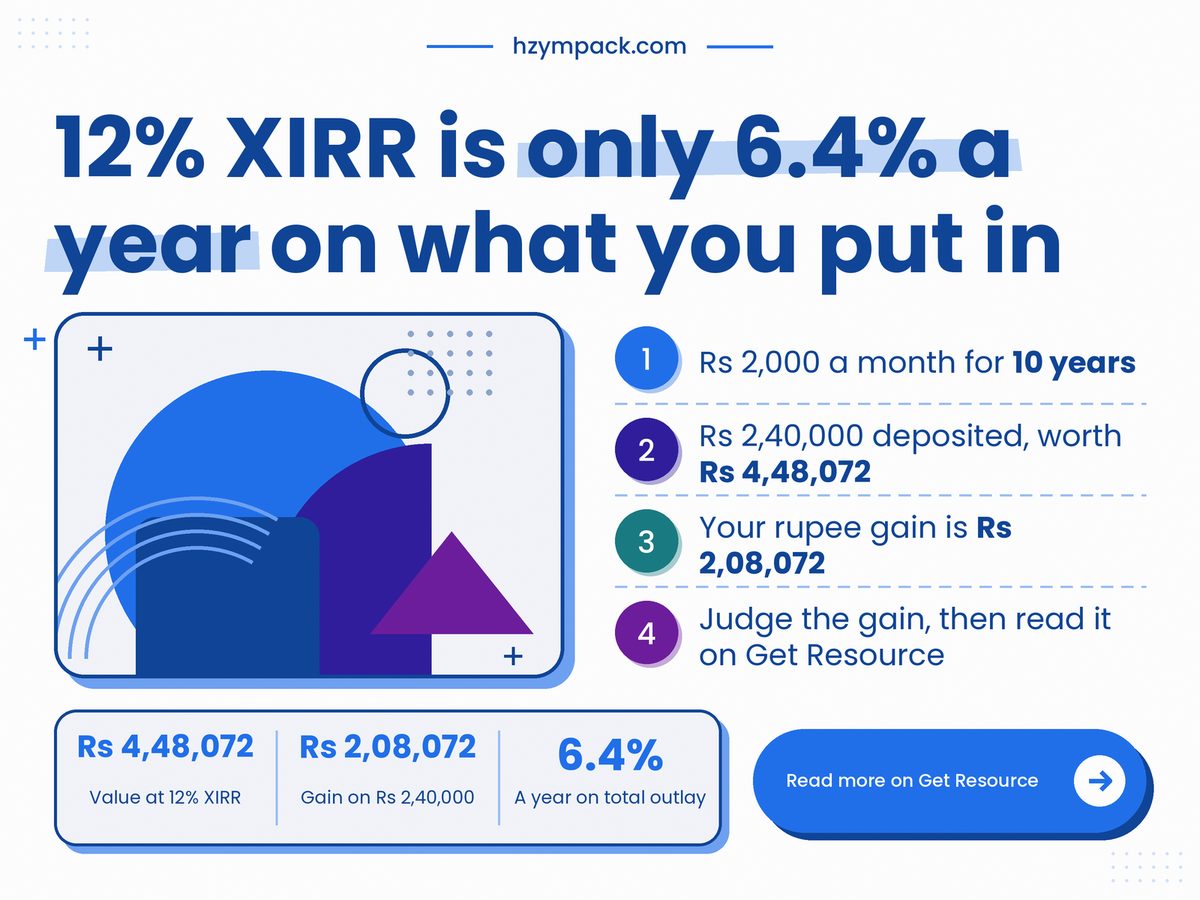
XIRR is arithmetically right, but it hides how few rupees a small SIP earns, so judge the rupee gain on your total outlay, not the headline rate.
- A Rs 2,000 SIP at 12% XIRR for ten years earns about 6.4% a year on the money you actually deposited.
- Fund-house tables omit load and tax; equity gains above Rs 1.25 lakh a year pay 12.5%.
- Do the one-minute check below with your own app: value divided by money put in, annualised.
Why do SIP returns in rupees tell you more than XIRR?
Because XIRR is a rate, not a result: it says how fast each rupee grew while it was invested, and says nothing about how many rupees there were or how long they stayed. Value Research is right that CAGR is the wrong yardstick for a SIP. Call the complaint a quibble about presentation. Actually, no: when only the flattering number is printed, presentation is the whole problem.
In August 2025 Value Research reported a seven-year SIP investor on Reddit who put in Rs 11 lakh, saw barely Rs 16 lakh, and called it a 7-8 per cent CAGR. Value Research recomputed an XIRR of about 10.97 per cent, close to the Nifty 50's 11.13. One anonymous post, not a statistic: same money, two verdicts, and no fund page says which to trust.
Who sets the presentation? Not SEBI, going by its circular of 22 October 2018, which I read as reproduced by TaxGuru, not from SEBI's own PDF. It asks for scheme returns against the Total Return Index as CAGR over fixed periods. SIP returns and XIRR do not appear, so the SIP percentage is house style, and house style can omit rupees. We saw the same loud pledge and quiet fine print in Ford's 2021 India service pledge against its shrinking network; on household money more widely, see India's tax trap.
The footnotes are blunter:
- Axis Mutual Fund (as on 31 October 2025) applies XIRR to “say Rs. 10,000” a month, five times your Rs 2,000.
- Baroda BNP Paribas (as on 31 December 2024) assumes a regular plan, so plan cost is inside the percentage and load and tax are not.
- It adds that past performance “should not be used as a basis of comparison with other investments”.
These four numbers come from Rs 2,000 on the first working day of each month for ten years at a steady 12% XIRR, our arithmetic, set out below.
Time to Double Your Deposits
11 years
Until gain equals deposits (derived)
LTCG Tax on Selling Everything
Rs 10,384
Derived, one financial year, 12.5% rate
Deposits Over the Decade
Rs 2.4 lakh
Your own money, not returns
Yearly Rate on Total Outlay
6.4%
Derived, against the 12% quoted
Early instalments have years to compound, so stopping halfway does not give half the result: five years reach roughly a third of what ten do, on our arithmetic.
A 12% XIRR on a Rs 2,000 SIP would earn about 6.4% a year on every rupee deposited. Both figures are correct; only one tells you what reaches your account.
How much will a Rs 2,000 monthly SIP become in 10 years?
At a steady 12% XIRR it becomes about Rs 4.5 lakh from Rs 2.4 lakh deposited, while 8% gives roughly Rs 3.6 lakh and 15% about Rs 5.3 lakh, before load and tax.
Worked example: assume Rs 2,000 on the first working day of each month, as in the Axis and Baroda footnotes, for 120 months at a constant 12% XIRR. Monthly rate: 1.12^(1/12) − 1 = 0.9489%. Value: 2,000 × ((1.009489^120 − 1) ÷ 0.009489) × 1.009489 = Rs 4,48,072. Deposits: 2,000 × 120 = Rs 2,40,000, so the gain is Rs 2,08,072. As a day-one lump sum, those deposits need 6.4% a year to reach that pile. Real XIRR uses actual dates, so expect small differences.
Your turn, in one minute. Divide your app's current value by the money put in (1.87 above), raise it to the power of one over your years with the x^y key, and subtract 1. Expect a rate well below your XIRR: the average instalment works for only half the term.
Find your years down the left and read across at your quoted XIRR. Cells are value in lakh (1 L = Rs 1,00,000), before load and tax.
| Years in | 8% XIRR | 12% XIRR | 15% XIRR |
|---|---|---|---|
| 5 years | 1.47 L | 1.62 L | 1.75 L |
| 10 years | 3.63 L | 4.48 L | 5.26 L |
| 15 years | 6.80 L | 9.52 L | 12.33 L |
| 20 years | 11.45 L | 18.40 L | 26.54 L |
The shaded cell is the worked example; one step right adds about Rs 0.8 lakh, one step left removes about Rs 0.85 lakh. Going from 15 to 20 years adds more than the first fifteen years' whole gain.
Of every Rs 100 this SIP is worth at the end, Rs 54 is your own deposits coming back, so the headline rate describes under half the money. Derived from the worked example, before load or tax.
What takes the rupees away after the fund page stops counting?
Load, tax and plan cost all come off after the table ends: the fund page excludes the first two outright, and the third is the regular-plan cost its numbers assume.
The CBDT's FAQs on the 2024 changes, published by PIB, set long-term gains on equity-oriented funds at 12.5% above Rs 1.25 lakh a year and short-term gains at 20%, from 23 July 2024; Business Standard reported Budget 2026 left long-term rates unchanged for FY27. Selling the worked example in one year owes the tax in the grid, on our estimate, slightly more as the final year's units are short-term. Confirm current rates with a chartered accountant first.
Then the quieter leak: your statement shows whether your folio is Regular or Direct, so check before comparing percentages. Our call: a recurring debit deserves a yearly statement of rupees in, rupees now and rate on outlay. The UK is heading that way (our reading of its subscription rules).
- Ask your platform for amount invested and current value, not only XIRR.
- Compare funds over identical start and end dates.
- Spread sales across financial years only if you do not need all the money at once; each year has its own Rs 1.25 lakh exemption.
Check these about your own SIP
- Your fund page shows a Rs 10,000 illustration and your instalment is a fifth of it.
- Your statement says Regular, so a distributor's cost is already inside the percentage.
- You may sell over Rs 1.25 lakh of long-term gain in one year.
Our call: keep XIRR, but never accept it alone. This week, open your latest statement, note the money put in and its value, and run the one-minute sum above to decide whether the rupee gain justifies your plan and monthly amount. If your folio is already Direct, go straight to the tax check.
How we checked this
We read the SEBI circular of 22 October 2018 as reproduced by TaxGuru, the Axis Mutual Fund SIP page as on 31 October 2025 and the Baroda BNP Paribas SIP page as on 31 December 2024. The worked example is our own arithmetic: Rs 2,000 on the first working day of each month, a steady 12% XIRR, monthly compounding. No fund was tested hands-on for this article. Last verified: 31 October 2026. Edited by Shajini, reviewed after publication. Spotted something out of date? Tell us and we will correct it.
No comments:
Post a Comment